Syndromic Object
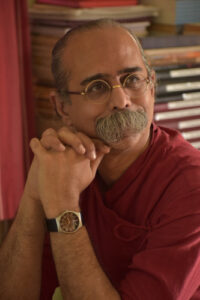
Ashish Avikunthak
Outside India (Incl. Shipping) : $75
India (Incl. Shipping): ₹3000
PRE-ORDER
Release Date : December, 2026
Design : Barnali Bose
Edition : 500
Details : Hard Case Book
Pages: 260
ISBN : 978-81-976080-0-1
Sometimes an object is the only evidence we have of something we cannot quite understand. We may not know what it signifies, where it comes from, or even what question it is answering. Yet a peculiar object, a faint stain, a torn photograph, a disentangled fragment, or a feeble trace can become a clue to a condition that remains unnamed. Ashish Avikunthak calls such a thing a “syndromic object:” an artifact that appears to function as a symptom of an intimate psychic, social, or historical state that resists clear diagnosis.
Neither a simple tool nor a stable symbol, the syndromic object occupies a liminal space where memory, absence, desire, decay, and uncertainty converge. It persists as a residue of experience, bearing witness to histories, anxieties, and forms of being that remain only partially visible, inviting interpretation while never yielding itself completely to understanding.
Syndromic Object is a hybrid photo-text work that explores this relationship between materiality and meaning. Bringing together photography and writing as equal and interdependent modes of thought, the book does not treat images as illustrations of text or text as explanations of photographs. The book invites readers into a world where every object carries the possibility of revelation, where decay becomes a form of memory, and where the most ordinary fragment can open onto profound questions about history, identity, and the nature of human existence itself.
Drawn from several decades of looking, wandering, collecting, and observing, the photographs in the volume record Avikunthak’s encounters with objects suspended between presence and disappearance. Across these images, people frequently appear only indirectly, through the traces they leave behind: a goddess’s feet worn smooth by devotion, a torn pair of sandals abandoned on a roadside, old studio portraits, family photographs fading in damp rooms, damaged film negatives, discarded household objects, fragments of architecture, stains, debris, and accumulations of dust.
The accompanying text does not seek to interpret or decode the photographs. Rather, it unfolds as a parallel stream of meditation, moving through questions of memory, archaeology, photography, desire, mortality, and the afterlife of things. At times philosophical, at times autobiographical, and at times speculative, the writing approaches objects as repositories of experiences that can no longer be fully recovered. The text and images continually intersect and diverge, creating a field of associations that remains deliberately open-ended.
Syndromic Object is a meditation on the relationship between things and being. It asks what happens when objects outlive their makers, how material remnants become the archives of forgotten worlds, and whether the things we leave behind continue to speak after we are gone.
Artist Biography
Ashish Avikunthak is a filmmaker, cultural anthropologist, and archaeologist whose work is internationally recognized for its philosophical depth, formal rigor, and sustained engagement with ritual, temporality, memory, and Indian epistemologies. Since the mid-1990s, his films have been screened, exhibited, and discussed at major international museums, festivals, and cultural institutions, including Tate Modern, Centre Pompidou, the Berlinale, and the film festivals of London, Locarno, and Rotterdam. Working at the intersection of cinema, philosophy, and anthropology, Avikunthak has developed a distinctive cinematic practice that challenges conventional narrative forms while probing questions of history, myth, religion, and everyday life. His oeuvre has recently been the subject of the edited volume The Epistemic Archaeology of Ashish Avikunthak: Cinema and Religiosity of Everyday Life (Bloomsbury Academic, 2025). He is also the author of Bureaucratic Archaeology: State, Science and the Past in Postcolonial India (Cambridge University Press, 2021). Currently, he serves as Professor of Film/Media at the Harrington School of Communication and Media, University of Rhode Island.